Answer Summary
ChatGPT Ads launched in India in late August 2026 for Free and ChatGPT Go users. This guide covers how ChatGPT Ads work, how context hint targeting differs from keyword bidding, setting up campaigns via OpenAI Ads Manager (min ₹725/day), tracking with UTMs and Pixels, early performance benchmarks, and integrating paid AI ads with organic Generative Search Optimization (GSO).
How to Set Up ChatGPT Ads in India: Strategy & Setup Guide (Sept 2026)
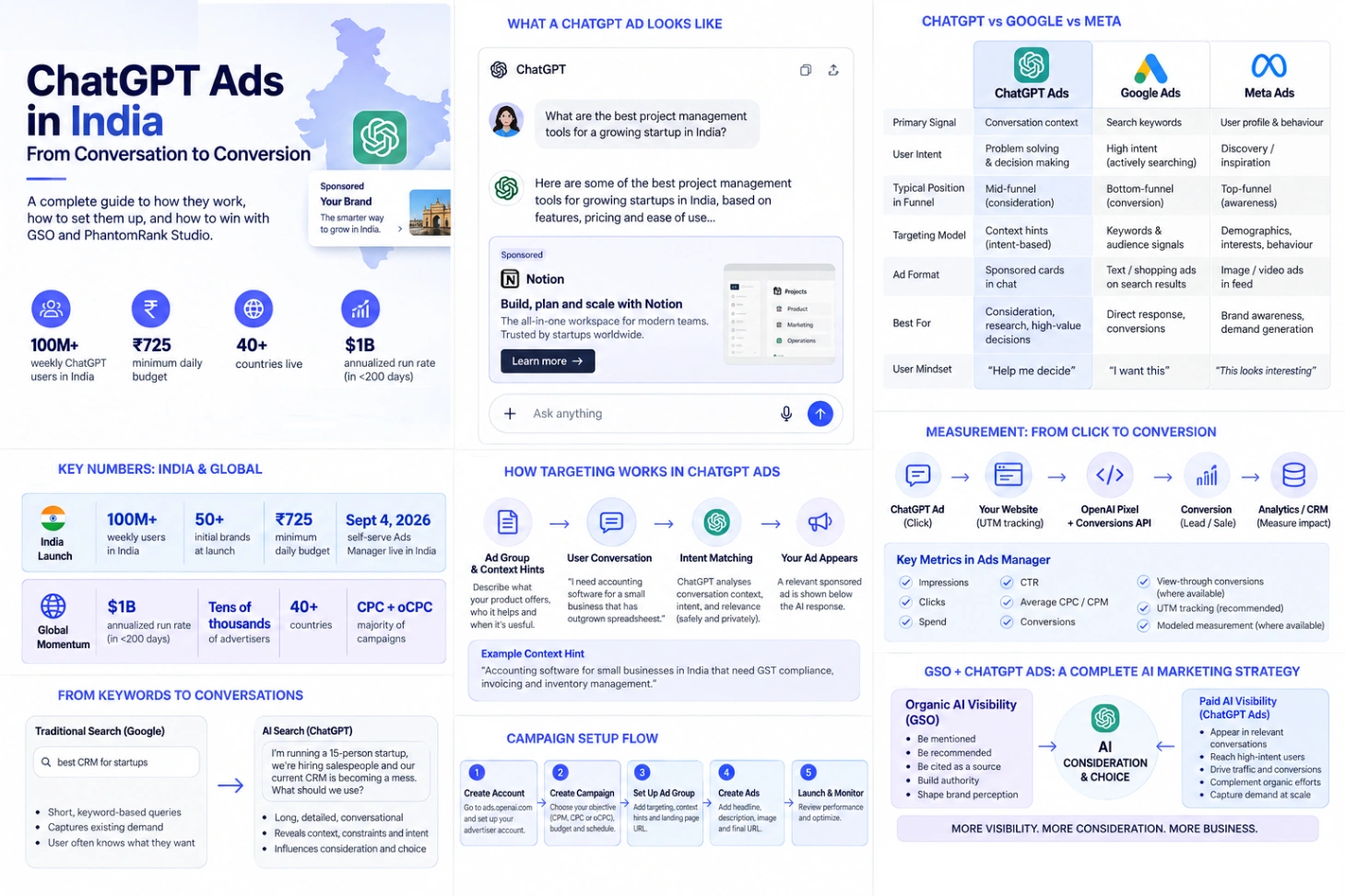
ChatGPT’s ad platform is the latest addition to the digital marketer’s toolkit. In late August 2026, OpenAI began showing sponsored messages below ChatGPT answers for Indian users on the Free and ChatGPT Go tiers.
The rollout, backed by WPP and Omnicom, starts with 50+ launch partners and a self-service Ads Manager (minimum ₹725/day) coming online in September. Indian businesses—riding on over 100 million local ChatGPT users—are now eager to experiment with this channel.
In this guide, we cover everything marketers need: what ChatGPT Ads are, how they work, how to set them up in India, early performance signals, and how to integrate them into your growth strategy.
What Are ChatGPT Ads (and How Do They Work)?
ChatGPT Ads are conversational “bottom-of-chat” ads that appear after the AI’s answer in a chat. In practice, when a user asks something (for example: “Best CRM for my 20-person sales team?”), ChatGPT generates its response, and beneath it a sponsored card may appear.
Each ad unit includes the advertiser’s name/logo, a headline, short description, and an optional image and landing-page link.
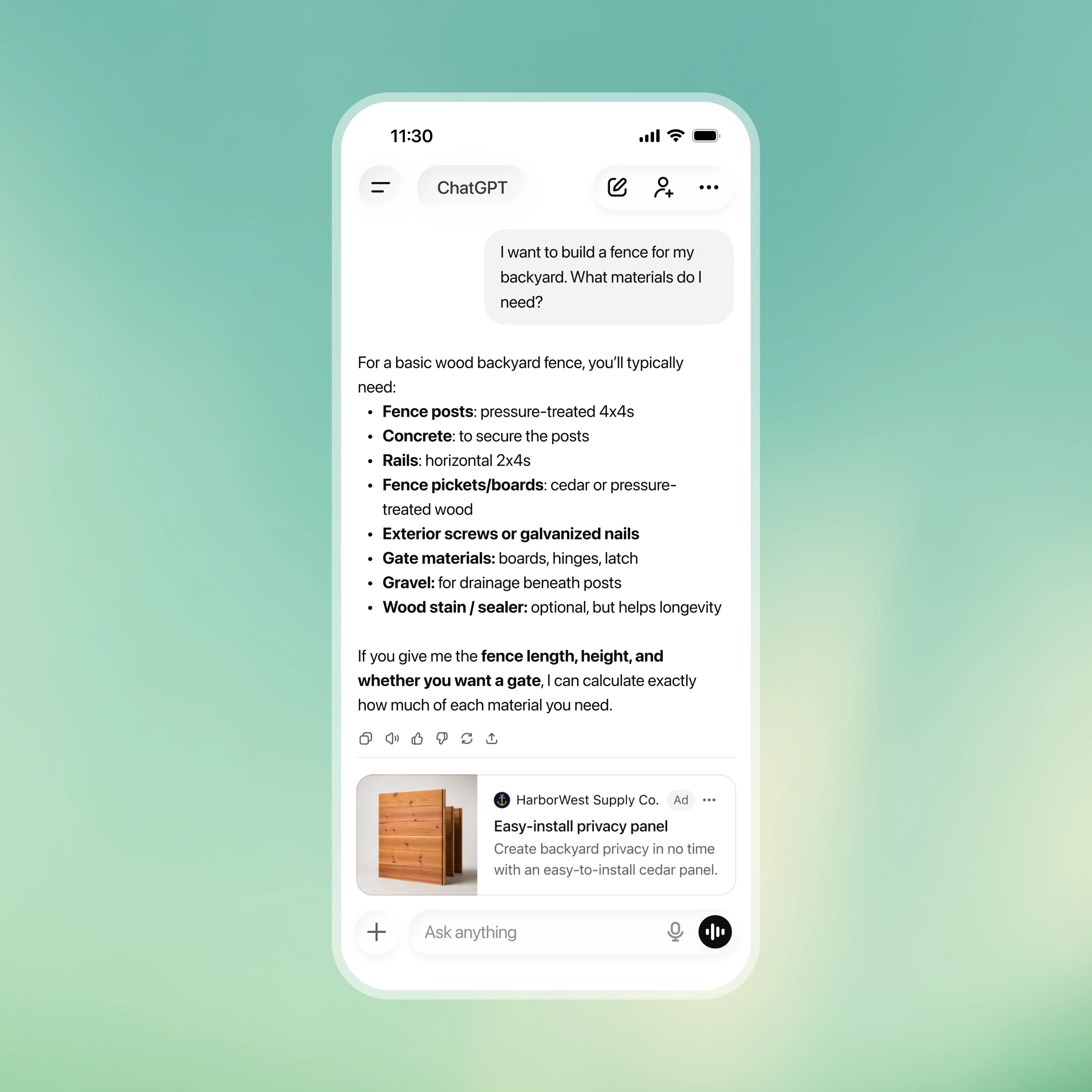
Example ChatGPT ad format: Sponsored content is clearly labeled (e.g. “HarborWest Supply Co. — Ad”), with a concise title and description, and an optional image. Ads are shown below the AI’s answer.
Importantly, ChatGPT Ads are kept entirely separate from the AI’s answer. OpenAI has repeatedly emphasized that ads do not influence ChatGPT’s response—the answers remain “independent and unbiased”. Advertisers bid to have their ad shown after ChatGPT provides its answer.
In fact, OpenAI’s principles guarantee that ads are always labeled “Sponsored” or “Ad” and are visually distinct, so users can easily differentiate organic answers from paid messages. This separation is critical for trust: users know the ad is inserted by OpenAI’s auction, not the AI’s reasoning.
The targeting logic behind each ad is driven by conversation context and intent. Unlike Google’s keyword auctions, ChatGPT’s system matches ads based on signals such as:
- The topic and intent of the current chat
- Broader usage patterns (if personalized ads are allowed)
- Ad copy and landing page content
- Advertiser-supplied “context hints”
In other words, the AI looks at what you’re discussing, not just a search query, and chooses the most relevant ad. For example, if you’re discussing budget travel, you might see a local hotel ad even if you never explicitly searched for one.
India’s Massive Opportunity for ChatGPT Ads
India is a strategic launch market for ChatGPT Ads. OpenAI CEO Sam Altman announced in Feb 2026 that India already has over 100 million weekly active ChatGPT users, second only to the U.S. Many of these users are on the free or low-priced ChatGPT Go plans (for which OpenAI even ran a year-long free promo). That makes India one of the largest captive audiences for ChatGPT Ads globally.
TechCrunch reports that OpenAI is targeting this market aggressively: as of Aug 27, 2026, ads began showing to Free and Go users in India. The initial launch includes 50 major brands (plus WPP/Omnicom agency partners) and—crucially—the Ads Manager platform is opening to Indian advertisers too.
From Sept 4, anyone in India can sign up for ChatGPT Ads with a daily budget as low as ₹725 (~$7.60). In comparison, Google Search Ads often require much higher spend to see traction. The low entry point means small businesses and startups can test the channel, not just big multinationals.
OpenAI has also tailored its pricing for India. Last year it introduced ChatGPT Go, a low-cost subscription (~$5 or less) aimed at the price-sensitive Indian market. In effect, India now has:
- Free Tier: Ad-supported
- ChatGPT Go: Low-cost paid tier (ads also enabled)
- ChatGPT Plus / Pro / Enterprise: Higher tiers (remain 100% ad-free)
That ladder means India can monetize the huge free user base via ads (and upsell some to paid) while keeping premium customers happy. For Indian marketers, it means the user funnel splits: non-paying users will see your ads in ChatGPT, whereas Plus/Pro subscribers won’t. This gives flexibility to target mass-market consumers without alienating premium subscribers.
Setting Up ChatGPT Ad Campaigns
If you’re sold on trying this channel, you’ll use OpenAI’s Ads Manager (ads.openai.com) to create campaigns. The workflow is similar to other platforms but adapted to AI’s context. Key steps:
1. Choose an Objective & Bid Type
Currently there are two main campaign objectives: Reach (CPM) and Clicks (CPC). For Reach, you pay per 1,000 impressions. For Clicks, you pay per click. (OpenAI also offers oCPC campaigns that optimize for conversions but still bill on a CPC basis.) Advertisers set a max bid at the ad group level (e.g. $3–$5 USD per click is the suggested starting point).
2. Ad Groups & Context Hints
Each campaign is divided into ad groups targeting a particular context. Unlike Google’s keyword-based ad groups, ChatGPT Ads uses Context Hints—phrases or descriptions that capture relevant conversation scenarios. You should provide a range of hint examples for where your product fits.
For instance, instead of targeting the keyword “CRM”, you might hint at “cloud CRM for 10-employee startups hiring salespeople.” The system uses these hints (plus conversation content) to match ads.
3. Creative (Headline, Description, Image)
Craft concise, benefit-driven ads. OpenAI advises “clear, specific, benefit-focused copy” that explains what you offer, who it’s for, and when it’s useful. Headlines should directly state the value (e.g. “CRM Built for Growing Startups”), and descriptions should expand on it with straightforward language. Provide multiple headline/description pairs for each offering; the AI will test different combinations. Include an eye-catching image if possible (ensure it’s relevant and not too cluttered). All ads must comply with OpenAI’s policies.
4. Landing Page & Tracking
Link each ad to a relevant page on your site (ideally a product or use-case page, not just the homepage). Ensure the landing page allows OpenAI’s crawler (OAI-AdsBot) to access it and that you append UTM parameters for analytics tracking. You can also install OpenAI’s conversion Web Pixel or use the Conversions API to measure ad-driven sales.
In short: map out your funnel by tracking impressions, clicks, and whatever downstream actions matter (sign-ups, leads, purchases).
5. Targeting & Context Matching
In ChatGPT Ads, targeting is mostly contextual, not by keyword. You can target by geography, language, or device, but there isn’t a built-in search query. What matters is the conversation topic and intent. OpenAI notes that ads are selected based on the “context and intent of the current conversation” along with your context hints and landing page.
Thus, focus your targeting strategy on understanding customer intent profiles. For example, if you sell personal loans in Mumbai, your context hints might include queries about “starting a small business,” “opening a shop,” or “bank loans for entrepreneurs.” The ad system will match those user intents with your ads.
Targeting & Intent: ChatGPT’s Conversational Difference
One of the most important shifts with ChatGPT Ads is the move from keywords to conversations. On Google Ads you bid on search terms. On ChatGPT, you bid on situations. The platform isn’t waiting for a crisp “search query”—the user is already asking ChatGPT (possibly long, complex questions) and in the middle of a decision conversation. So:
Context Over Keywords
ChatGPT takes cues from the full text of the conversation. Advertisers supply context hints (not exact-match keywords) to guide relevance. The system might show your ad if your hint matches the user’s problem, even if the exact wording differs.
As one PPC marketer put it:
“It’s not really keyword targeting in the traditional sense. It’s a single text box per ad group and I’ve been treating it more like writing a GPT prompt than keyword targeting.”
This means you should think in user scenarios. For instance, for a project management tool, instead of targeting “project management software,” you might hint at “team planning for 20-person agency.”
The Decision Stage
ChatGPT Ads aims at users in mid-decision, not just top-of-funnel interest. Marketers note that ChatGPT traffic is often “curiosity clicks for days”—users exploring or comparing options. One agency observer noted:
“The traffic is real but the intent’s just not there yet… maybe works for top-of-funnel brand stuff but direct response? Not seeing it.”
In other words, ChatGPT is more about influencing a decision than capturing an immediate “I’m ready to buy” moment. Compare that to Google Search, which catches users with explicit purchase intent (e.g. typing “buy CRM software”). And compare to Facebook/Meta, which reaches users broadly as they browse content.
ChatGPT sits in between: the user isn’t at the awareness stage (they’ve signaled a need by asking ChatGPT), but they often haven’t committed to a choice.
Because of this, your creative and funnel strategy should adjust. Rather than a hard sell, ads should inform and nudge. For example: “Learn how X-Tool can save time for your agency” might work better than “Buy X-Tool now.” Keep messaging helpful, not pushy.
This insight also underscores the value of a hybrid approach: use Google/Meta for direct response and use ChatGPT Ads for consideration influence.
Measuring Results (Pixel, API, Privacy)
Tracking ChatGPT Ads is still maturing. OpenAI’s Ads Manager currently reports impressions, clicks, spend, CTR, avg CPC/CPM, and conversions. To measure actual business outcomes, you should integrate:
- Ads Pixel / Conversions API: OpenAI supports a web pixel (like Facebook Pixel) and a server-side Conversions API for e-commerce or lead tracking. When a user clicks an ad and lands on your site, the pixel can fire events (page view, purchase, etc.). The Conversions API can send those events directly to OpenAI. This lets you optimize oCPC campaigns or just track ROI.
- UTM Parameters: As a basic measure, append UTM tags to your landing page URLs in the ad. This ensures clicks can be identified in Google Analytics or your CRM. ChatGPT Ads reporting itself doesn’t yet break out detail like “this ad was shown on what prompt.” So UTM parameters and parallel GA tracking are crucial to tie ChatGPT ad clicks to actual conversions.
- Privacy Controls: By design, advertisers do not get access to chat conversations or user identities. OpenAI states that ads respect user privacy: “Advertisers do not have access to your chats, chat history, memories, or personal details… only receive aggregate performance (views/clicks).” Users can also opt out of personalized ads.
This means you won’t see which exact user or conversation triggered your ad. Attribution will rely on after-the-fact analytics (GA, CRM, etc.) and incremental testing. Keep in mind: multichannel attribution here is tricky. A customer might first discover you via ChatGPT, then later search or click an email. As always, use mixed models and holdout tests if possible to gauge incrementality.
ChatGPT Ads vs. Google & Meta: Different Funnels
Many marketers wonder if ChatGPT Ads will steal budget from Google or Facebook. The consensus so far: no, it’s complementary.
ChatGPT is not (yet) a replacement for Google Search Ads. In practice, Google Search yields direct intent traffic (people actively searching to buy). Meta reaches users broadly (interest/affinity based). ChatGPT Ads inserts your message in a conversation context—essentially at the consideration stage of the funnel.
As one PPC forum comment noted:
“Google captures existing intent pretty directly, while ChatGPT is more about influencing the consideration/recommendation stage.”
In fact, early testers find that ChatGPT clicks feel more “upper funnel”—lots of browsing and few purchases. For example, an ad might get many clicks from someone comparing products, but those users might later drop off to research offline.
That’s not a bad thing, but it means we need different KPIs. Expect lower immediate conversion rates than Google; instead look for metrics like engagement, assisted conversions, or lift in branded searches.
Use ChatGPT Ads alongside your Google/Meta campaigns: capture bottom-funnel demand on Google, maintain awareness/consideration in ChatGPT, and retarget or convert with follow-up channels.
Early Performance Signals
What do the first users of ChatGPT Ads see? Early numbers and anecdotes are mixed:
- Ad Performance Metrics: Several analyses report low CTRs and limited spend so far. A CampaignLive article cites Adthena finding a ~0.91% CTR on one ChatGPT campaign—seven times lower than the 6.4% Google benchmark for that sector. Another report (SE Ranking) found that in over 96% of AI answers, the ad’s brand wasn’t even mentioned by ChatGPT, and fewer than 20% of eligible users saw an ad per day. In practice, advertisers are seeing click-through rates in the sub-1% range and paying high CPCs (commonly around $7–$10 a click). One agency case had an average CPC of $7 and reported no conversions from the campaign.
- Conversion & ROI: Most current users report very few sales directly from ChatGPT Ads. For example, a test campaign with ~$50 spend produced 0 leads. Another advertiser spent $400 for only 3 conversions. One Reddit marketer noted “lots of clicks but only 1 conversion,” while getting far more conversions from organic ChatGPT referrals than from paid ads.
- User Trust: An entirely different issue is user reaction. Many ChatGPT users find the ads jarring. One user quipped on Reddit: “I got my first ad while using chat… I immediately started deleting all of my prompts and I am never signing on again. I don’t trust anything that’s going to advertise.” Others complain the ads feel too intrusive.
These performance signals are not necessarily permanent. OpenAI is iterating rapidly: it has already expanded geographies, improved relevance algorithms, and promises richer formats ahead. For now, though, marketers should approach ChatGPT Ads with a test-and-learn mindset.
Sample Pilot Strategy for India
If you’re ready to experiment, start small and measure carefully:
- Budget & Scope: Run a pilot with ₹10k–₹25k/month ($120–$300) on ChatGPT Ads for one product line or campaign, while keeping your regular Google/Meta campaigns running. The ₹725 daily minimum means you can try even a single-ad campaign for just ₹725/day.
- Targeted Creatives: Use specific context hints. For instance, if you sell accounting software to SMEs, create ads around one scenario (“accounting for 5-person Mumbai startup”), and write benefit-focused copy for that scenario. Test different headlines/descriptions as OpenAI suggests.
- Comparison A/B: If possible, mirror this ChatGPT audience on Google/Meta. E.g., for two similar products, run one on Google Ads search and the other on ChatGPT Ads and compare incoming leads.
- Landing Page Optimization: Since ChatGPT Ads weigh landing-page relevance, ensure your page delivers exactly what the ad promises. Include a clear summary (“BLUF” capsule) at the top of the page so ChatGPT (and users) immediately see the core value.
- Metrics to Watch: Don’t just watch CTR or clicks. Track actual leads or sign-ups. Even if ChatGPT Ads don’t convert on the first click, they may assist future purchases. Use UTM-tagged funnels and look for lift in branded searches or site visits after starting ChatGPT campaigns.
PhantomRank Studio: How We Can Help
ChatGPT Ads is uncharted territory, but PhantomRank has been preparing for this moment. We offer services that bridge AI visibility and AI advertising:
- AI Market Audits (Industry Metrics): We can run a comprehensive audit of your category in ChatGPT (and other AI engines). This identifies where your brand currently shows up in AI answers—who are the leaders, which intents you’re missing, and which competitor ads dominate. It’s an “AI Share of Voice” map.
- Campaign Strategy & Setup: We’ll help you configure your ChatGPT Ads campaign properly: defining objectives, context hints, creative variations, and measurement (pixel/CAPI/UTMs). We draw on best practices so your ads align with user intent.
- Generative Search Optimization (GSO): Beyond ads, we strengthen your brand’s organic AI presence. Our GSO framework ensures your website is constructed so AI engines readily cite it. We follow the “3 Golden Rules”: direct answer summaries (BLUF) at the top of pages, verifiable facts at high density, and structured JSON-LD schema (FAQPage, HowTo, Product, etc.) so that when ChatGPT pulls sources, it finds you authoritative.
- Performance Insights: We’ll measure and report not just on ads metrics but on AI-driven outcomes. For example: “In 1,000 relevant ChatGPT prompts we ran, your brand was mentioned 18% of the time, whereas Competitor X was mentioned 42%.” Or “Your ads appeared in 25% of relevant chats, but the AI’s answer mentioned you only 5% of the time.”
In short, ChatGPT Ads is a new channel—but it sits on top of the broader shift to AI search. PhantomRank can guide you through both sides. We’ll make sure your ads target the right conversations and that your site and brand are part of the conversational answer when it matters.
Sources: Official OpenAI docs and announcements; Tech news on the India rollout; OpenAI financial disclosures; Practitioner reports and analyses. (Citations embedded in text.)