Stop guessing what ChatGPT says about you.
See how AI engines like ChatGPT, Gemini, Perplexity, Grok, and NVIDIA mention your brand, link to your site, and compare you to competitors
Tracking AI visibility across:




If AI can’t see you, buyers won’t
PhantomRank shows how AI answers talk about you and your competitors, at both brand and industry level.
Brand-level AI visibility tracker
Monitor one brand across ChatGPT, Gemini, Perplexity, Grok, NVIDIA and more, including how often AI chooses competitors instead.
- • Compare your mentions and descriptions to competitor brands in real AI answers.
- • Catch cases where AI engines crawl your pages but cite someone else instead.
- • Track semantic resonance so you know whether AI understands your positioning or mislabels you.
Industry-level visibility & competitor analysis
Audit your whole category to see which brands AI engines consistently recommend, ignore, or warn against.
- • Map the AI-era leaderboard: Leaders, Challengers, Niche players.
- • Find information gaps where no one is serving good data and your content can become the default source.
- • Analyse sentiment and placement to understand how AI frames each competitor’s strengths and weaknesses.
Trusted by forward-thinking brands & agencies





How PhantomRank measures AI search visibility
Classic SEO tracks blue links. AI search visibility is about whether AI mentions you, cites you, or chooses someone else. PhantomRank's Brand-level AI Visibility Tracker breaks that behavior into three layers:
Mentions
AI answers where your brand is named.
Citations
Answers where your domain is actually linked as a source.
Crawl pool
Answers where AI crawled your page, read it, and still cited a competitor instead. This is the gap most tools miss entirely.
Competitive AI visibility in your category
Audit your niche and see who AI assistants considers Leaders and Challengers to see exactly where you're ahead or behind.
AI Share of Voice
Who gets mentioned most.
Share of Synthesis
Who gets cited as a primary source, not just named.
Answer Placement & Sentiment
How prominently, and how positively, AI describes each brand.
Multi-engine AI visibility, one workflow
PhantomRank runs conversational, buyer-journey prompts across ChatGPT, Gemini, Claude, Grok, and Perplexity simultaneously. It logs every answer, citation, and crawl-pool result, semantic resonance to check how closely those answers match your brand's actual positioning.
Run buyer-journey prompts
ToFu, MoFu, and BoFu questions across multiple AI engines at once.
Log answers, citations, crawl pool
Capture what AI says, which domains it links, and which pages it quietly crawls.
Compute semantic resonance
Use vector math to compare AI descriptions against your brand DNA.
Compare brands fairly
Same prompts, same time window, so you and your competitors are measured on identical runs.
Turn AI visibility data into a practical content plan
PhantomRank doesn't stop at visibility snapshots. You tune the questions you ask AI, run them on a recurring cadence, map the generative supply chain your brand sits in, and turn the findings into concrete SEO and content actions.
From observation to intervention
Three stages: see where you stand, see why, and see where to intervene in the AI supply chain.
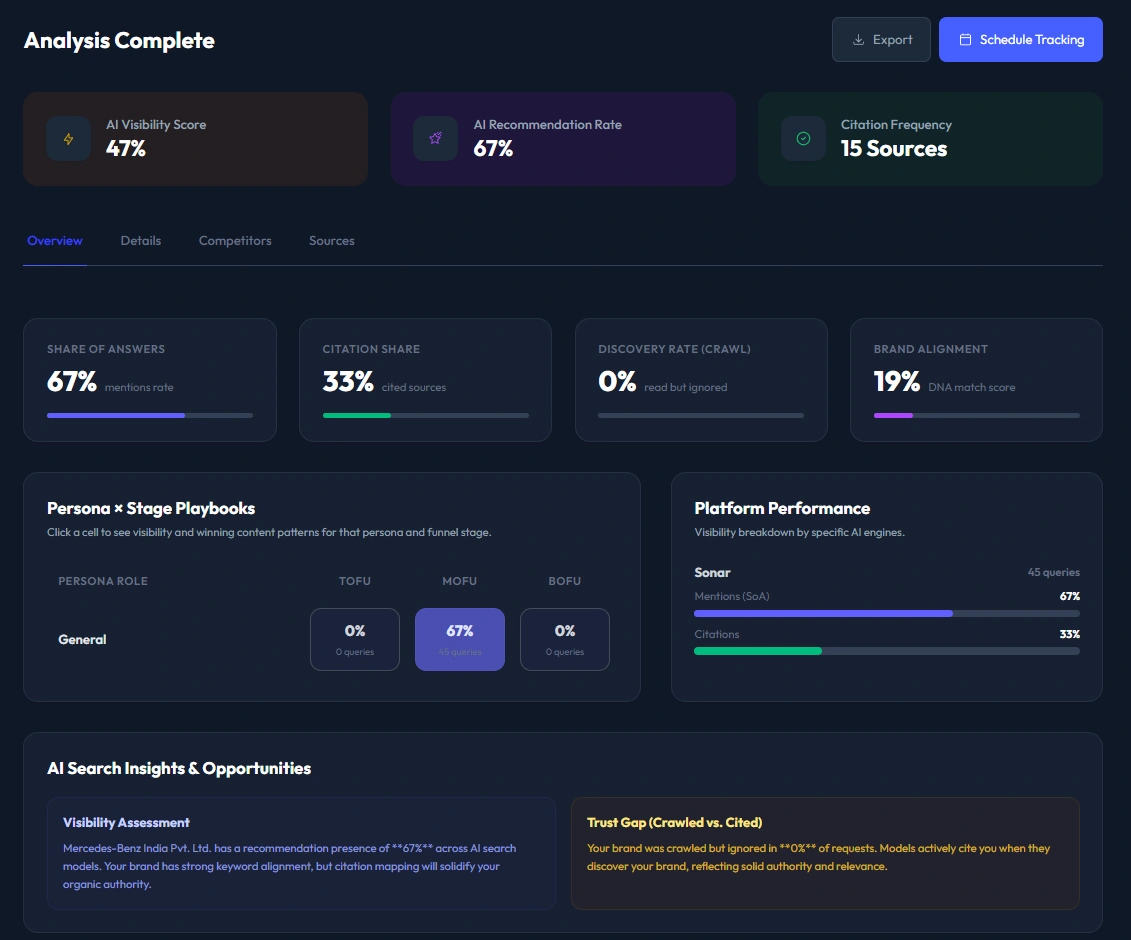
See how AIs talk about you
See your visibility layers at a glance: mentions, citations, crawl-pool gaps, and your semantic resonance score — for one brand, across five AI engines.







See where you're winning or losing
A live leaderboard of your category: AI Share of Voice, Share of Synthesis, and Answer Placement, benchmarked against 15–20 competitors.
See where to intervene upstream
Information gaps turned into a content calendar — the exact topics AI is currently answering badly, ranked by opportunity.
Who uses PhantomRank
In-house SEO / AI search teams
Use the Brand-level AI Visibility Tracker to catch visibility issues before competitors do.
Content and brand marketers
Use the strategy layer to turn information gaps into a content calendar AI will actually crawl and cite.
Digital marketing and SEO agencies
Use Industry Metrics audits and AIVT reports as a paid AI-visibility-audit add-on for clients.
Frequently asked questions
Everything you need to know about AI visibility tracking and search intelligence.
AI visibility is how often, and in what context, your brand shows up when people ask AI assistants like ChatGPT, Gemini, Claude, Grok, or Perplexity for recommendations. Most teams still measure this by manually typing prompts into each chatbot and eyeballing the results — which doesn't scale past a handful of queries. PhantomRank automates that process: it runs your brand through dozens of buyer-journey prompts across all five engines on a schedule, so you get a real measurement instead of a spot-check.
It's a probability, not a rank — and any tool selling you a fixed position is misrepresenting how AI actually works. Because AI answers vary run to run, the useful metric is how often your brand appears across repeated queries — for example, showing up in 6 of 10 runs of the same prompt category, tracked over time. That's how PhantomRank reports visibility: as a trend built from repeated, structured measurement, not a single lucky (or unlucky) snapshot.
They're the same discipline evolving, not a separate one — but the mechanics genuinely shift. Traditional SEO optimizes to rank; GEO and AEO optimize to be cited inside a generated answer. That means structure matters more (self-contained sections, clear verdicts, comparison tables) and keyword density matters less. PhantomRank tracks both sides: whether you show up (visibility) and whether AI trusts you enough to cite you as a source (synthesis).
It makes word-for-word tracking pointless, which is exactly why PhantomRank doesn't do that. Instead of comparing exact phrasing, we convert each AI response into a vector embedding and measure its semantic similarity to your brand's core messaging — a method we call semantic resonance. The wording can shift every time the model answers; the underlying meaning, and therefore the resonance score, stays stable enough to actually track over weeks and months.
By never handing the model your brand name to begin with. If a prompt already contains your brand, you're testing whether the AI can repeat a name you gave it — not whether it surfaces you naturally. PhantomRank runs category-level, persona-based prompts that mirror how real buyers actually ask ('best CRM for a 10-person agency'), so what comes back reflects genuine visibility, not a fed answer.
Partially, and PhantomRank is built to close that gap rather than pretend it doesn't exist. Attribution from AI tools is genuinely harder than from Google — most people don't type 'found you on ChatGPT' into a lead form. What you can do is correlate periods of higher Share of Synthesis with pipeline and self-reported attribution, and track referral traffic from the citations AI does generate. It's directional, not perfect — and we'd rather tell you that than oversell a dashboard that claims otherwise.
Not from the AI platforms themselves — none of them offer an official visibility dashboard the way Google Search Console does. That's the specific gap PhantomRank fills: one dashboard that queries ChatGPT, Gemini, Claude, Grok, and Perplexity on a recurring schedule and gives you the equivalent view — mentions, citations, and crawl behavior — that Search Console gives you for classic search.
Content built in self-contained, quotable chunks — not classic long-form narrative blog posts. AI engines pull cleanly from sections that work as standalone answers, put a clear verdict in the first two or three sentences, and use structured formats like comparison tables and FAQs. PhantomRank's Information Gap Analysis tells you which specific topics in your category AI is currently answering badly, so you know exactly where writing this kind of content will move the needle.
A mention means AI named your brand in its answer. A citation means it linked back to your site as a source. The gap between them matters more than most teams realize: a brand mentioned constantly but never cited is winning awareness and losing referral traffic. PhantomRank tracks both separately — AI Share of Voice for mentions, Share of Synthesis for citations — because optimizing for one doesn't automatically improve the other.
ChatGPT, Gemini, Claude, Grok, and Perplexity — across 28 model variants — the engines Indian and global buyers actually use for research and recommendations, tracked in one place instead of five separate manual checks.
It's when an AI engine crawls your page while researching an answer, reads it, and still chooses to cite a competitor instead. That's not an awareness problem — your site was found — it's a content relevance or authority gap, and it's specific enough to fix.
No tool can guarantee that, and any tool claiming 'control' over AI answers isn't being straight with you. PhantomRank gives you an accurate diagnostic of where you stand today — including the probability-based visibility and semantic resonance scores above — and a content roadmap to close specific, identified gaps.
In the era of clickless search, AI visibility is your new competitive advantage
PhantomRank gives you the diagnostics, competitor benchmarks, and concrete content strategy to build visibility where your next buyers are actually looking.