The Complete Guide to Generative Engine Optimization (GEO)
Your client ranks #1 on Google for “industrial automation software.” Strong domain authority. Solid backlink profile. Organic traffic growing steadily.
Yet when a buyer asks ChatGPT to recommend solutions, your client isn’t mentioned. Perplexity cites three competitors. Gemini recommends a completely different set of brands.
This is the GEO gap—and it’s costing your clients pipeline every day. 94% of B2B buyers now use AI tools like ChatGPT during their purchasing journey, and 50% start their software buying journey inside an AI chatbot rather than a search engine. If your client’s content isn’t structured for AI citation, they’re invisible in the channel that increasingly drives discovery.
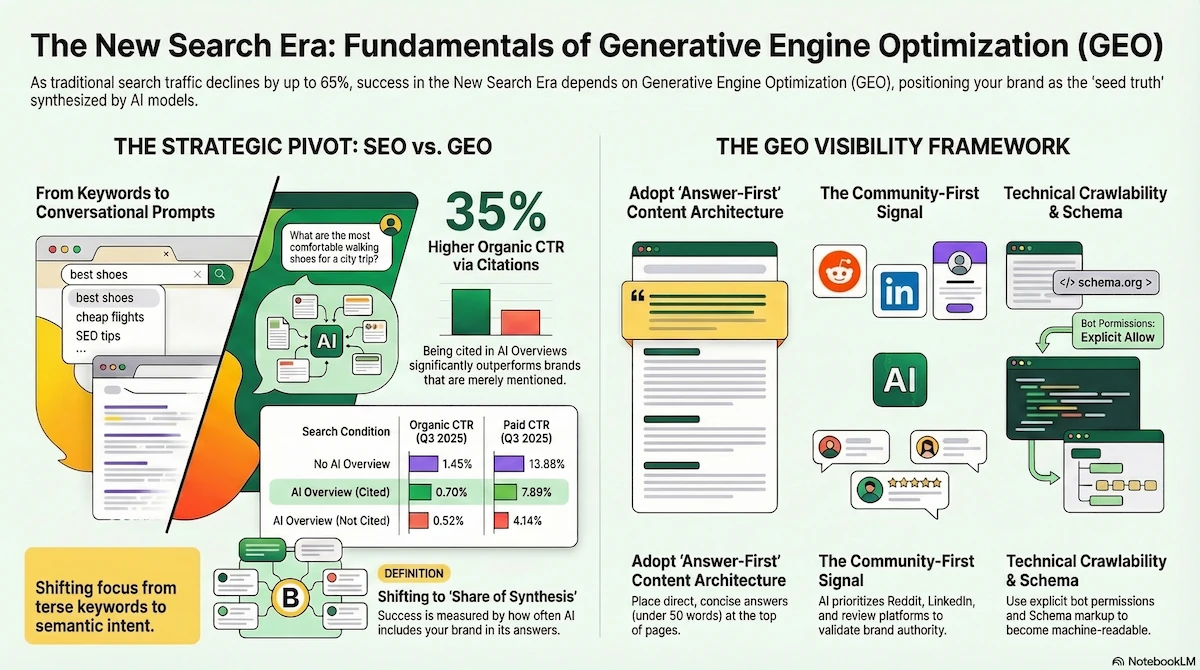
Generative engine optimization is the practice of structuring, formatting, and positioning content so AI-powered answer engines—ChatGPT, Perplexity, Gemini, Claude, and others—cite, recommend, and reference your brand when users ask conversational queries.
In this guide, you’ll learn what GEO is, how it differs from traditional SEO, which ranking factors actually drive AI citations, how to optimize content platform by platform, and how to measure results for your clients.
What Is Generative Engine Optimization?
Generative engine optimization (GEO) is the systematic process of optimizing content to increase the likelihood that large language models will cite, reference, or recommend your brand in AI-generated responses.
When a user asks Perplexity “What’s the best CRM for e-commerce businesses?”, the platform doesn’t return a ranked list of web pages. It generates a synthesized answer by retrieving information from multiple sources, evaluating relevance and authority, and composing a natural language response. Your brand either makes it into that synthesis—or it doesn’t.
GEO ensures your content is structured in ways that AI systems can discover (via web crawls, sitemaps, and real-time search), extract (pull relevant facts, quotes, and data from your pages), evaluate (determine your content is authoritative and trustworthy), synthesize (incorporate your information into generated answers), and cite (attribute information to your domain as a source).
If traditional SEO is about winning the click, GEO is about winning the recommendation.
How Has Search Shifted From Engines to Answer Engines?
Traditional search engines index, rank, and present links. Answer engines retrieve, synthesize, and present answers. That fundamental difference changes everything about how content gets discovered.
The traditional search journey looks like this: user types a query, Google returns 10 ranked links, user clicks 1–3 results, user reads content on the destination site. The AI answer journey works differently: user asks a conversational question, ChatGPT or Perplexity generates a synthesized answer, the answer includes recommendations and citations (or no attribution at all), and the user may click a citation link—or may not.
In the second flow, your brand must be part of the synthesized answer to exist at all. There’s no “scroll down to see more results.” If AI doesn’t mention you, you’re invisible to that buyer.
The scale of this shift is hard to overstate. ChatGPT now processes over 800 million weekly active users and handles 2.5 billion prompts per day. Perplexity’s monthly visits have surged 191.9% year-over-year, reaching over 155 million visits in March 2026. Google AI Overviews now appear in 13% of all searches. These aren’t niche platforms—they’re where your clients’ prospects are actively researching.
How Does GEO Differ From Traditional SEO?
The core difference between SEO and GEO comes down to one word: synthesis. SEO optimizes for selection (getting clicked from a list). GEO optimizes for synthesis (getting included in a generated answer).
This distinction matters for every tactical decision your agency makes. Research from Ahrefs found that the primary source of AI mentions isn’t your own website—it’s third-party sites like industry lists, reviews, and PR coverage. That’s a fundamentally different optimization target than traditional on-page SEO.
| Dimension | SEO (Traditional) | GEO (Generative AI) |
|---|---|---|
| Objective | Rank high in SERPs | Be cited in AI-generated answers |
| Target platform | Google, Bing | ChatGPT, Perplexity, Gemini, Claude, AI Overviews |
| Success metric | Keyword rank position | Mention rate + citation frequency |
| Content goal | Match search intent with keywords | Provide extractable, citable facts |
| Link building | Backlinks boost domain authority | Citations demonstrate content authority |
| Optimization focus | Title tags, meta descriptions, keyword density | Structured data, clarity, factual density, source attribution |
| Result format | Ranked list of URLs | Synthesized paragraph with optional citations |
| User behavior | Click-through to website | Read answer (with or without clicking sources) |
Brands in the top 25% for web mentions earn over 10x more AI Overview placements than the next tier down. That correlation between brand authority and AI visibility (0.664) is stronger than most traditional ranking factors—and it means GEO success depends on building your client’s overall digital presence, not just optimizing individual pages.
Why Does GEO Matter for Agencies Right Now?
Three converging forces make generative engine optimization essential for agencies in 2026. Understanding these forces helps you frame the conversation with clients and justify the investment.
How Fast Is AI Search Adoption Growing?
The numbers speak clearly. 87% of B2B software buyers say AI chatbots are changing how they research software, according to G2’s survey of 1,000+ buyers. Forrester’s 2026 buying report confirms that generative AI tools were the single most cited meaningful interaction type for researching purchases. And AI-generated referral traffic is growing at 40%+ month-over-month.
For agencies, this means your clients’ prospects are forming first impressions in an environment where traditional SEO rankings don’t apply. If your client isn’t optimized for GEO, they’re missing the fastest-growing discovery channel in B2B.
Why Don’t Traditional SEO Strategies Transfer to GEO?
Keyword density, exact-match anchor text, and title tag optimization—core SEO tactics—have minimal impact on GEO. AI systems evaluate content differently than search algorithms. They weight factual density, content structure, source authority, and entity recognition over keyword placement and meta descriptions.
A study analyzing 10,000 real-world queries found that pages with structured lists, quotes, and statistics had 30–40% higher visibility in AI responses than pages optimized purely for traditional SEO signals. This isn’t a tweak to your existing playbook—it’s a different optimization paradigm.
What’s the Competitive Window for Agencies?
Agencies that master GEO now gain 12–18 months of competitive advantage before the market catches up. Most agencies still don’t offer AI visibility services, which means the supply-demand gap is wide open. The first agency to show a prospect their competitive AI visibility gap wins the pitch—and the retainer.
What Are the Core GEO Ranking Factors AI Engines Evaluate?
Generative AI platforms use fundamentally different ranking signals than traditional search engines. Understanding these factors is the foundation of every effective GEO strategy your agency delivers.
How Important Are Content Clarity and Structure?
AI systems extract information by identifying clear, structured assertions. Ambiguous or meandering content gets ignored—no matter how well it ranks on Google.
Research from SE Ranking’s analysis of 129,000 unique domains found that pages with 120–180 words between headings receive 70% more citations than pages with sections under 50 words. Content with consistent heading hierarchy is 40% more likely to be cited.
What AI rewards:
- Clear topic sentences: Leading each section with explicit claims
- Structured hierarchies: H2/H3 headings that organize information logically
- Bulleted facts: Lists that AI can extract and cite easily
- Definitions and explainers: Content that directly answers “What is X?”
- Comparison tables: Side-by-side feature comparisons AI can surface whole
What AI ignores: vague marketing language (“We’re the industry-leading solution…”), opinion without evidence, walls of unstructured text with no headings, and content heavy on storytelling but light on facts.
GEO best practice: Write like a technical documentation author, not a copywriter. Lead with facts, organize hierarchically, define terms explicitly.
Why Does Factual Density Drive Citations?
AI engines prioritize content with high information density—specific facts, data points, and concrete examples. The difference between citable and uncitable content often comes down to specificity.
High factual density: “According to our 2025 SaaS Pricing Survey of 847 B2B companies, the average cost per user for project management software is $23/month, with enterprise plans ranging from $15–$45 depending on feature access and admin controls.”
Low factual density: “Project management software pricing varies widely depending on the vendor and features included. Most platforms offer tiered pricing to accommodate different business sizes.”
The first example provides a specific data source, sample size, exact metrics, range context, and context variables. AI can extract and cite this. The second example is vague and uncitable. Adding statistics with sources improves AI visibility by 22–28% across platforms.
GEO best practice: Replace generalities with specifics. Add numbers, dates, study citations, and concrete examples to every key claim.
How Do Source Authority and Trust Signals Affect GEO?
AI systems evaluate whether content comes from authoritative, trustworthy sources. 96% of AI Overview citations come from sources with strong E-E-A-T signals, and pages with 15+ recognized entities show 4.8x higher selection probability.
Authority signals AI tracks:
- Domain reputation: Established domains with strong backlink profiles
- Author credentials: Bylines with author bios, LinkedIn profiles, publication history
- External citations: Content that cites authoritative sources signals you respect evidence
- Freshness: Recently published or updated content (within 12 months)
- Entity recognition: Brand mentioned in trusted databases (Wikipedia, Crunchbase, industry publications)
PhantomRank’s citation source analysis shows exactly which domains AI engines trust most in your client’s category, giving agencies a backlink target list optimized for GEO rather than traditional PageRank.
What Role Does Structured Data Play in GEO?
AI engines parse structured data to understand content context and relationships. Implementing schema markup doesn’t guarantee citation, but it dramatically improves AI’s ability to extract and attribute information correctly.
High-impact schema types for GEO:
- Article schema: Identifies content as authoritative publication
- FAQPage schema: Marks Q&A content as directly answerable
- HowTo schema: Structures step-by-step guides for AI extraction
- Product schema: Defines product attributes AI can cite
- Organization schema: Establishes entity relationships
GEO best practice: Implement schema markup on all cornerstone content. Verify that your robots.txt does not block AI crawlers (OAI-SearchBot for ChatGPT, PerplexityBot, Google-Extended for Gemini). Consider adding an llms.txt file to guide AI systems on how to interpret your site.
How Does Conversational Query Alignment Work?
AI engines respond to natural language queries, not keyword-stuffed phrases. This is where GEO differs most from traditional SEO strategy—when someone asks an AI a complex question, the AI breaks it into smaller sub-queries (called fan-out queries) and searches for each one separately.
For example, if someone asks ChatGPT “What is the best email marketing platform for a small e-commerce business with less than 10,000 subscribers?”, the AI might search for “best email marketing platforms 2026,” “email marketing e-commerce features,” and “email marketing pricing small business.”
GEO best practice: Map content to conversational queries using intent types (informational, commercial, navigational, comparison). Create content that directly answers full questions—and make sure you rank for the fan-out sub-queries too. PhantomRank’s 9 intent types cover the full spectrum, ensuring you track visibility across every stage of the buyer journey.
How Do You Optimize Content for AI Citation?
GEO strategy translates into five tactical optimization areas. These are the specific changes your agency can make to client content that drive measurable improvements in AI visibility.
How Should You Rewrite Content for Extractability?
Audit existing content through an AI lens: Can ChatGPT extract clear facts from this page? Articles over 2,900 words are 59% more likely to be cited in ChatGPT, but length alone isn’t enough—structure matters more.
Before (traditional SEO copy): “Our platform helps teams collaborate more effectively by bringing all project communication, task management, and file sharing into one unified workspace.”
After (GEO-optimized): “TeamSync consolidates project communication in three modules: (1) Real-time chat with threaded conversations, (2) Kanban-style task boards with custom workflows, and (3) 500GB cloud storage integrated with Google Drive and Dropbox. Average setup time is 15 minutes.”
The second version gives AI a specific product name, three distinct features, integration details, and a quantifiable metric. Each of those data points becomes a potential citation trigger.
Action: Rewrite vague benefit statements into specific, structured feature descriptions across your client’s highest-traffic pages.
Why Should Every Cornerstone Page Have an FAQ Section?
AI engines love Q&A format content because it matches conversational query structure. When a buyer asks “How much does [product] cost?”, AI searches for pages that answer that exact question—and FAQ sections wrapped in FAQPage schema are prime extraction targets.
Structure each FAQ with a clear question as the H3 heading and a 2–3 sentence answer that leads with the specific answer before adding context. Wrap the entire section in FAQPage schema to signal AI that this content is directly citable.
Action: Add FAQ sections to all pillar pages, product pages, and comparison guides.
How Does Comparison Content Boost AI Citations?
AI engines cite comparison content more frequently than product pages because comparisons answer “Which one should I choose?” queries directly. Comparison tables receive 47% higher citation rates in Google AI Overviews than paragraph-only alternatives.
High-value comparison formats include head-to-head product comparisons (“[Your Product] vs [Competitor]”), segmented recommendations (“Best [Category] for [Use Case]”), and matrix-style tables comparing features across 3–5 tools. Structure each comparison with an overview, evaluation criteria, individual breakdowns with pros and cons, a feature matrix table, and “Best for X” guidance.
Action: Create 3–5 comparison guides targeting your client’s top competitive keywords.
What Kind of Data Earns AI Citations?
Original research, surveys, and proprietary data earn citations because AI can attribute specific facts to specific sources. This is the single highest-ROI content investment for GEO.
Citation-worthy data looks like: “According to our 2026 AI Visibility Report, 64% of B2B buyers discover new vendors through AI search.” Or: “Our analysis of 1,200 SaaS pricing pages found the median enterprise tier starts at $199/user/month.” AI can extract these claims, link them to your domain, and cite you as the source—something it can’t do with generic marketing copy.
Action: Publish 1–2 data-driven reports annually. Promote them to earn backlinks and third-party citations.
How Often Should You Refresh Content for GEO?
AI engines have a strong recency bias. Content updated within the last 12 months is significantly more likely to be cited, and Perplexity in particular favors recent content with visible “last updated” timestamps—delivering 30% more citations to fresh pages.
Refresh priorities: update statistics with current figures, add recent examples referencing 2025–2026 developments, revise product information to reflect current features and pricing, and expand FAQ sections based on new questions from support tickets and sales calls.
Action: Set quarterly content refresh cycles for your client’s top 20 pages by traffic.
How Do You Optimize for Specific AI Platforms?
Different AI platforms behave differently. Only 11% of domains are cited by both ChatGPT and Perplexity, which means a one-size-fits-all approach misses most of the opportunity. Effective GEO requires platform-specific tactics layered on top of universal best practices.
What Does ChatGPT Prioritize When Citing Sources?
ChatGPT has the largest user base (800–900 million weekly active users), making it the highest-ROI optimization target. But it rarely cites sources—only about 20% of mentions include links.
ChatGPT-specific tactics:
- Focus on entity recognition: Get your brand into structured knowledge graphs. ChatGPT favors well-known, digitally-native brands and Wikipedia accounts for 47.9% of its top citations.
- Use clear product categorization: “X is a [category] tool that [specific capability].”
- Build comprehensive guides: Long-form content (2,500+ words) performs better for ChatGPT mentions.
- Cite authoritative sources in your content: Show AI you respect evidence—it builds trust signals.
How Is Perplexity’s Citation Behavior Different?
Perplexity is the opposite of ChatGPT in one critical way: it cites almost everything. Perplexity tied every claim to a specific source in 78% of complex research questions, compared to ChatGPT’s 62%. That transparency means getting cited is achievable—but your content needs to be bulletproof.
Perplexity-specific tactics:
- Publish recent content: Perplexity’s real-time retrieval architecture heavily favors content from the last 6–12 months.
- Use specific data points: Numbers, statistics, and survey results get extracted first.
- Structure for scannability: Bullet lists, comparison tables with clear headers, and 40–60 word lead paragraphs optimized for extraction.
- Implement Article schema: Helps Perplexity identify authoritative content.
Perplexity users skew technical and research-oriented—these are high-quality B2B leads your clients want.
What About Gemini and Google AI Overviews?
Gemini integrates deeply with Google’s index, giving it massive distribution. The overlap means tactics that work for Google AI Overviews transfer to Gemini—and AIO-optimized keywords trigger 849% more Featured Snippets than non-AIO queries, so you’re hitting two targets at once.
Gemini-specific tactics:
- Leverage existing Google presence: Gemini pulls heavily from Google’s index—strong organic rankings are the foundation.
- Use structured data extensively: Gemini prioritizes schema-marked content.
- Build entity relationships: Get mentioned on Wikipedia, Crunchbase, and industry publications.
- Optimize comparison tables: Comparison tables receive priority treatment from Google’s AI systems.
What’s the Universal Cross-Platform Strategy?
Rather than optimizing separately for each platform, focus on universal GEO principles that work everywhere:
- Clarity: Write clearly structured, factually dense content.
- Authority: Build backlinks and entity recognition across the web.
- Freshness: Update content quarterly with visible timestamps.
- Extractability: Format for AI parsing (headings, lists, tables, schema).
- Citation-worthiness: Include original data and specific, sourceable facts.
PhantomRank tracks visibility across Perplexity (with ChatGPT, Gemini, and Grok on the roadmap), giving agencies a single dashboard to measure cross-platform GEO performance.
How Do You Measure GEO Success?
GEO requires different metrics than traditional SEO. Your client reporting needs to reflect what actually matters for AI visibility—and translate those metrics into business outcomes they care about.
What Are the Six Metrics That Matter?
- Citation Rate — Percentage of AI answers that cite your content as a source. Target: 15–25% citation rate across tracked prompts. Improve by adding original data, implementing Article schema, and earning backlinks.
- Mention Rate — Percentage of AI answers that mention your brand (with or without citation). Target: 40–60% for category-defining queries. Improve by strengthening entity recognition, building content clusters, and refreshing regularly.
- Share of Voice by Intent Type — Your brand’s percentage of total mentions across different query intents (informational, commercial, comparison). Target: 30%+ SOV in high-intent queries. PhantomRank’s 9 intent types let agencies track share of voice across the full buyer journey.
- Source Diversity — Number of unique URLs cited by AI engines. Target: 8–12 different pages cited across tracked prompts. Improve by building content hubs that interlink deeply and optimizing multiple page types.
- Competitive Displacement — How often you replace a competitor in AI answers over time. Target: +10% quarter-over-quarter displacement of the #1 competitor in your category.
- Traffic From AI Referrals — Sessions originating from chat.openai.com, perplexity.ai, gemini.google.com, etc. Target: 5–10% of total organic traffic from AI referrals. Set up custom channel groups in Google Analytics 4 to isolate AI traffic from other referral sources.
PhantomRank reports these metrics in client-ready dashboards. Agencies can export branded PDFs that translate raw GEO data into strategic recommendations justifying retainer fees.
What Are the Most Common GEO Mistakes to Avoid?
Agencies transitioning from SEO to GEO often make predictable errors. Knowing these pitfalls in advance saves your team months of wasted effort.
-
Treating GEO like keyword stuffing. Adding “ChatGPT optimization” keywords to existing content doesn’t work. AI doesn’t rank keywords—it evaluates factual quality and structure. Rewrite content for clarity and factual density, not keyword density.
-
Ignoring content freshness. Publishing once and never updating is a GEO killer. AI prioritizes recent content, and a 2024 guide with no updates will lose ground to a 2026 article on the same topic. Set quarterly refresh cycles.
-
Focusing only on product pages. AI cites educational guides, comparisons, and data reports far more than product pages. Build content hubs that cover category concepts, comparisons, and use cases—not just feature lists.
-
No cross-platform tracking. Optimizing for ChatGPT but ignoring Perplexity and Gemini means missing leads from platforms that serve different audiences. Use PhantomRank or similar tools to track visibility across all major platforms simultaneously.
-
Forgetting entity building. Optimizing content without strengthening brand entity recognition limits GEO impact. AI won’t recommend brands it doesn’t recognize as legitimate category players. Build entity presence through Wikipedia, Crunchbase, industry publications, and backlinks from trusted domains.
What’s Next: How Do You Move From GEO to Full AI Search Strategy?
GEO is one component of a comprehensive AI search strategy. Once you’ve optimized content for AI citation, you need to connect it with the broader picture:
- AI Visibility Tracking: Measure performance across platforms with structured, intent-driven analysis
- Answer Engine Optimization (AEO): Optimize for Google AI Overviews and featured snippets
- Agency Workflows: Package GEO as a client service that drives recurring revenue
Continue learning:
- GEO vs SEO: Key Differences and Strategies — Side-by-side comparison of ranking factors, optimization tactics, and success metrics
- How to Optimize Content for ChatGPT Citations — Platform-specific optimization guide with examples
- Perplexity AI Optimization: How to Rank in Perplexity — Citation-focused tactics for Perplexity’s high-citation environment
- AI Content Optimization for Generative Engines — Step-by-step content rewriting framework
- The Complete Guide to AI Visibility Tracking — Measure GEO performance across platforms
Get Started With PhantomRank
PhantomRank’s AI Visibility Tracker runs GEO performance analysis across 45 strategic prompts and 9 intent types. See exactly how often your client’s content gets cited, which competitors dominate AI recommendations, and where optimization opportunities exist.
Run an Industry Metrics scan in under 10 minutes to benchmark your client’s GEO performance against category leaders.
Ready to optimize for the AI answers your clients’ prospects actually see? Get Access or See How It Works
Frequently Asked Questions
What is generative engine optimization (GEO)?
Generative engine optimization is the practice of structuring and formatting content so AI-powered answer engines—ChatGPT, Perplexity, Gemini, Claude, and Google AI Overviews—cite, recommend, and reference your brand in their generated responses. Unlike traditional SEO, which optimizes for keyword rankings in search results, GEO optimizes for inclusion and prominence in synthesized AI answers. It focuses on content clarity, factual density, structured data, source authority, and entity recognition to make your content extractable and citable by large language models.
How is GEO different from traditional SEO?
SEO optimizes for clicks from a ranked list. GEO optimizes for mentions and citations inside AI-generated answers. The ranking factors differ significantly: SEO depends heavily on backlinks, keyword placement, and domain authority, while GEO rewards factual density, content structure, entity recognition, and recency. Research shows that branded mentions across the web correlate with AI visibility at 0.664—stronger than most traditional ranking factors. The biggest shift is that GEO citations often come from third-party mentions of your brand, not just your own pages.
Which AI platforms should agencies optimize for?
At minimum, optimize for ChatGPT, Perplexity, and Google AI Overviews. Each behaves differently: ChatGPT has the largest user base (800–900 million weekly active users) but cites sources in only about 20% of mentions. Perplexity cites sources in 78% of complex responses but has a smaller audience. Google AI Overviews appear in 13% of all searches and integrate with traditional search. Only 11% of domains are cited by both ChatGPT and Perplexity, so a multi-platform approach is essential.
What content formats work best for GEO?
AI engines prefer content that is clearly structured, factually dense, and easy to extract. Comparison tables receive 47% higher citation rates. Pages with 120–180 words between headings get 70% more citations than those with shorter sections. FAQ sections with schema markup, step-by-step guides, and data-driven reports with specific statistics all perform well. Articles over 2,900 words are 59% more likely to be cited by ChatGPT, but structure matters more than length alone.
How long does it take to see GEO results?
GEO results follow a staged timeline. Citation increases typically appear in weeks 1–2 after optimization. Mention rate improvements follow in weeks 3–4. Share of voice shifts take longer—usually weeks 5–8 of sustained effort. Traffic and conversion lifts from AI referrals are lagging indicators, typically appearing in month 3 or later. Agencies can demonstrate GEO progress to clients within 30–60 days using citation and mention rate data, well before traditional SEO metrics would show movement.
How does GEO relate to Answer Engine Optimization (AEO)?
GEO and AEO are complementary disciplines within a complete AI search strategy. GEO targets conversational AI platforms (ChatGPT, Perplexity, Gemini, Claude) where users ask questions and receive synthesized answers. AEO targets answer-based SERP features (Google AI Overviews, featured snippets, People Also Ask boxes) where Google blends traditional results with AI-generated summaries. Strong AEO performance often feeds GEO success—AI platforms pull from featured snippets and high-ranking content when generating their own answers.
Can I measure GEO performance for client reporting?
Yes. The six key GEO metrics are: citation rate (percentage of AI answers citing your content), mention rate (percentage of AI answers naming your brand), share of voice by intent type, source diversity (number of unique URLs cited), competitive displacement (how often you replace a competitor), and traffic from AI referrals. PhantomRank tracks all six across platforms and exports client-ready branded PDF reports, making it straightforward to demonstrate GEO ROI during monthly reviews and quarterly business reviews.
How does PhantomRank help agencies with GEO?
PhantomRank runs structured AI visibility analysis across 45 strategic prompts and 9 intent types, giving agencies a clear picture of how client brands perform in AI-generated answers. It provides competitive benchmarking (who dominates AI citations in your client’s category), citation source mapping (which specific pages drive AI visibility), and share of voice tracking over time. Agencies can run an Industry Metrics scan on any category in under 10 minutes to identify GEO gaps—useful for both ongoing client reporting and new business pitches where showing a prospect their AI visibility gap wins the deal.