The Complete Guide to Answer Engine Optimization (AEO)
Your client can rank on page one and still lose the search.
That sounds counterintuitive until you look at how discovery works in 2026. A buyer searches a commercial query, sees a Google AI Overview, scans a featured snippet, opens a People Also Ask box, and forms an opinion before the first organic click even happens. If your client is not part of that answer layer, they are still technically visible, but strategically absent.
That is where answer engine optimization comes in.
Answer Engine Optimization, or AEO, is the practice of structuring content so platforms like Google AI Overviews, ChatGPT Search, Perplexity, and voice assistants can extract, understand, and cite it when users ask a question. Traditional SEO is built to help your client rank. AEO is built to help your client become the answer.
For agencies, this is not a side tactic. It changes how you pitch strategy, how you structure content, and how you defend a retainer. If your reports still focus only on rankings and clicks, you are missing the layer where more buyers are forming shortlists.
This guide breaks down what AEO is, how it differs from SEO and GEO, which content structures answer engines prefer, how to optimize for Google AI Overviews and featured snippets, and how to report answer visibility in a way that clients immediately understand.
What Is Answer Engine Optimization?
Answer engine optimization is the process of making content easier for search engines and AI systems to extract, summarize, and cite in direct-answer formats.
That includes surfaces like Google AI Overviews, featured snippets, voice assistant responses, People Also Ask boxes, and other search experiences where the user gets a synthesized response before clicking through to a page.
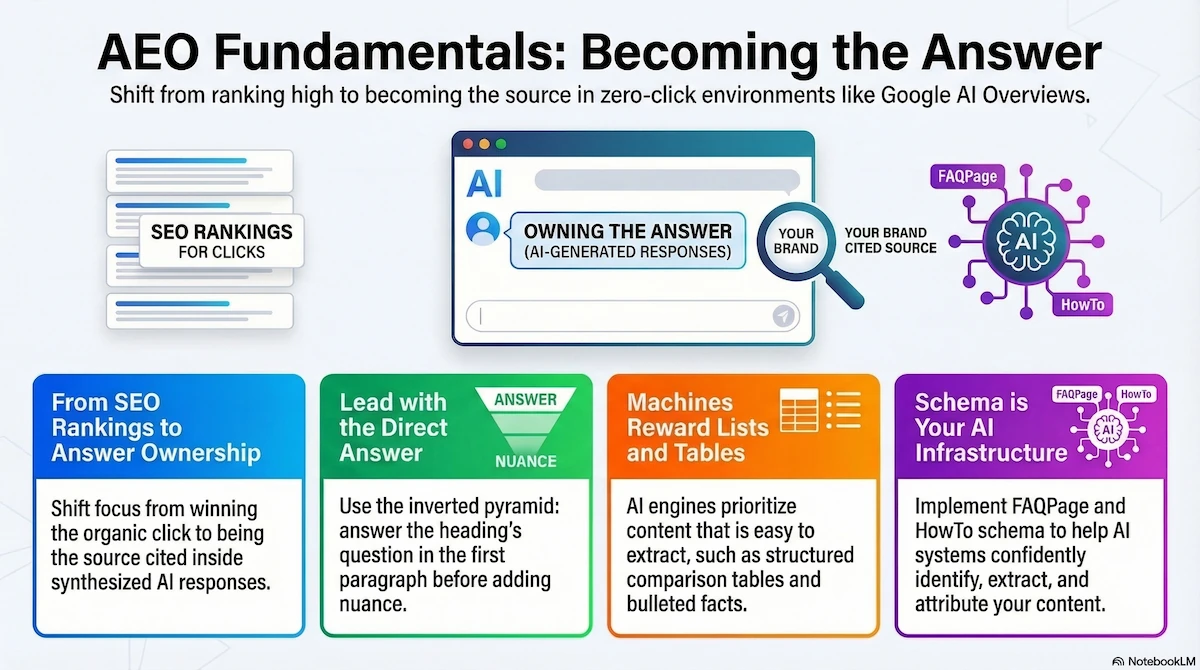
This is the core shift: in traditional SEO, your client competes for a blue link. In AEO, your client competes to be the source inside the answer.
That sounds like a subtle distinction, but in practice it changes how content has to work. A page can no longer rely on broad topical relevance alone. It needs to deliver direct answers, clean structure, strong trust signals, and enough specificity for a machine to quote it confidently.
Why does that matter for agencies?
Because your client does not care whether they ranked fifth if the AI Overview used three competitor sources and excluded them completely.
That makes AEO a commercial issue, not just a content issue. It affects category perception, research behavior, qualified traffic, and ultimately pipeline influence. For an agency, that creates a new layer of strategic work: you are no longer optimizing only for discoverability. You are optimizing for answer ownership.
How Is AEO Different From Traditional SEO?
Traditional SEO is about improving visibility in search results. You target keywords, strengthen technical performance, build internal links, earn backlinks, and push pages higher in the SERP.
AEO changes the objective. You still need those foundations, but the goal is not only to rank. The goal is to produce content that can be lifted into an answer box, cited in an AI Overview, or spoken back by a voice assistant.
Here is the practical difference:
| Dimension | Traditional SEO | Answer Engine Optimization |
|---|---|---|
| Primary goal | Rank in search results | Get cited or featured in the answer |
| Main success signal | Position, traffic, clicks | Answer inclusion, citation visibility, snippet ownership |
| Content structure | Comprehensive and keyword-aligned | Extractable, direct, question-led |
| Query targeting | Keyword phrases | Questions, intent clusters, entity relationships |
| Best result | Higher organic click-through | Presence in AI Overviews, snippets, voice answers |
AEO also differs from GEO. Generative Engine Optimization is focused more broadly on visibility across generative AI platforms like ChatGPT, Gemini, Claude, and Perplexity. AEO is narrower and more search-surface-specific. It is especially relevant for Google-driven answer experiences and the zero-click layer around them.
The relationship is simple:
- SEO builds the foundation.
- AEO improves answer-surface visibility.
- GEO expands that visibility across broader generative AI platforms.
That sequencing matters. As Gray Group International explains, most agencies get better returns by strengthening SEO first, then optimizing already-competitive content for answer extraction.
Why Does AEO Matter More in 2026?
Because the answer layer is no longer experimental. It is where attention is concentrating.
Search behavior has changed faster than many reporting models have. Buyers are increasingly comfortable asking long, specific questions and trusting synthesized responses. At the same time, search engines are serving more direct-answer formats that reduce the need to click through multiple sites.
That creates two realities agencies need to hold at the same time.
First, rankings still matter. Research cited in the original draft shows that a large share of AI Overview citations come from pages already ranking in strong organic positions. That means traditional SEO still does heavy lifting.
Second, rankings alone are no longer enough. A well-ranked page can still lose the most visible part of the SERP if it is not structured for answer extraction. That is the gap AEO closes.
For agencies, this creates three immediate opportunities:
- Audit work: Identify pages that rank but fail to appear in answer features.
- Content rewrite work: Restructure key pages for extractability, trust, and clarity.
- Reporting work: Add answer visibility and citation tracking into monthly deliverables.
That is valuable because it gives clients a more accurate view of search performance. It also gives your team a sharper narrative in a pitch. Instead of saying, “We improve rankings,” you can say, “We help your client show up in the answer before the click.”
What Makes Content More Likely to Be Cited by Answer Engines?
Answer engines tend to reward content that is easy to parse, easy to trust, and easy to quote.
That sounds simple, but it has specific editorial implications. Pages need cleaner structure, more explicit language, stronger sourcing, and tighter alignment with the real questions buyers ask.
Why is structure so important?
Machines need clean extraction points.
That is why direct summaries, question-led headings, short paragraphs, lists, tables, and obvious hierarchy matter so much. If the answer is buried under a soft introduction and three generic paragraphs, the page becomes harder to reuse in an answer surface.
This is also why the inverted pyramid works well for AEO. Lead with the answer. Add the explanation second. Add examples, supporting evidence, and nuance after that.
A practical pattern looks like this:
- Ask the question in the heading.
- Answer it in the first paragraph.
- Expand with supporting detail.
- Use bullets or tables where they genuinely clarify the point.
Why does semantic clarity matter?
Because AI systems do not want vague language.
A sentence like “this may help improve team collaboration in some cases” gives a search engine very little to work with. A sentence like “project management software centralizes task assignment, deadline tracking, and file sharing” is cleaner, easier to quote, and more trustworthy.
That does not mean writing robotic copy. It means writing declarative, useful copy. The strongest AEO content still sounds human. It just does not ramble.
Why do trust signals still matter?
Because answer engines still need to decide whether a source is reliable enough to cite.
Pages that reference authoritative material, show clear ownership, use accurate facts, and stay current are easier to trust. That is especially important for sensitive categories, but it applies more broadly as well.
This is where inline links do real work. Instead of parking references in a “Sources” section, the evidence should sit naturally inside the paragraph where the claim appears. If you reference Google’s own guidance on succeeding in AI search, that source strengthens the sentence in the exact place the reader and the machine need it.
Why does freshness matter?
Because stale content quietly loses eligibility.
If your client’s comparison page still reflects old pricing, outdated screenshots, and last year’s market framing, it becomes a weaker answer candidate. Pages that are reviewed and updated regularly stay more competitive in answer surfaces.
For most agency clients, that means building a refresh cadence around the pages most likely to influence commercial discovery:
- High-intent category pages
- Comparison pages
- FAQ-heavy support and solution pages
- Industry glossaries
- Pillar content targeting broad informational queries
How Should You Structure Content for Google AI Overviews?
Google AI Overviews are the most obvious AEO target because they sit directly inside Google’s results and shape how the SERP is consumed.
The first step is not rewriting content. It is identifying which queries actually trigger AI Overviews. Some searches still behave like traditional SERPs. Others are heavily answer-driven. Your AEO work should focus on the second group.
Once you know the right query set, structure the page around a repeatable answer-first format.
What does an AI Overview-friendly page structure look like?
A strong format usually includes:
- A clear H1 aligned with the core query
- Question-led H2s and H3s
- A direct answer in the first paragraph of each major section
- Lists or tables where they make the answer easier to extract
- Supporting detail below the summary
- A FAQ section covering adjacent user questions
- Helpful internal links to deeper cluster pages
That structure works for both people and machines. The reader gets the answer fast. The page still has enough depth to build trust and drive conversion. The engine gets clean sections it can summarize.
Why should headings be framed as questions?
Because that is closer to how real users search.
A heading like “Email Marketing Best Practices” is serviceable, but “What Email Marketing Tactics Drive the Highest Open Rates?” is easier to match to query intent. It also makes the content more extractable for answer surfaces.
That is why question-led H2s matter so much in AEO. They create semantic alignment without sounding forced, provided the page still reads naturally.
What content formats work best inside AI Overview-targeted pages?
The format should follow the query type.
- For definition queries, lead with a concise paragraph answer.
- For process queries, use step-by-step numbered lists.
- For comparison queries, use clean comparison tables.
- For feature or evaluation queries, use bullets and short sections with obvious subheadings.
Research referenced in the base draft points out that AI Overviews frequently pull lists and bullet structures from web content. That tracks with what agencies are seeing in practice: clearer structure increases extraction potential.
How Can You Win Featured Snippets More Consistently?
Featured snippets still matter because they sit in the same answer ecosystem. In many cases, snippet-optimized pages also become stronger candidates for AI Overview citation and voice answer selection.
The most important thing is to match the format Google already prefers for that query.
If the current snippet is a paragraph, give Google a better paragraph. If it is a numbered list, rewrite the section as a cleaner numbered list. If it is a table, build the comparison into a table with clear headers.
What does snippet-ready copy look like?
It usually follows a simple pattern:
- Put the question in the heading.
- Answer it immediately in 40 to 60 words.
- Expand with context below.
- Keep the opening answer self-contained.
For example, if the query is “How long does CRM implementation take?” the page should not open that section with a long paragraph about digital transformation. It should answer the question directly, then explain variables like company size, integrations, and data migration.
That is what makes the content both useful and extractable.
Why are snippets still a good starting point for agencies?
Because they are easier to reverse-engineer than broader AI systems.
You can search the query, inspect the current format, compare the source page, and improve your client’s page accordingly. That makes featured snippets a good operational entry point for agencies expanding from SEO into AEO.
How Does Schema Markup Support AEO?
Schema markup helps machines understand what your content is, how it is structured, and which parts of it are intended to answer questions.
It does not replace strong content. But it makes strong content easier to classify and extract.
For most AEO programs, the priority schema types are straightforward:
- FAQPage schema for FAQ sections and direct-answer blocks
- HowTo schema for step-by-step instructional content
- Article schema for editorial pages and pillar content
- Organization schema for publisher identity and authority context
What is the right way to use schema?
Use it as infrastructure, not as a shortcut.
If the visible content is weak, schema will not rescue it. If the FAQ section is thin, stuffing FAQ markup onto the page does not make it trustworthy. The content and the markup need to align.
That means:
- Use schema that matches the visible page format.
- Keep publication and update dates accurate.
- Validate implementation before publishing.
- Review schema when the page content changes.
Pages should also be checked in Google’s Rich Results Test so the technical work is not assumed to be correct without verification.
How Should You Approach Voice Search as Part of AEO?
Voice search is essentially answer engine behavior with less patience.
When someone asks a voice assistant a question, they are not looking for a menu of options. They want one usable response. That makes concise, conversational structure even more important.
FAQ content tends to perform well here because it mirrors the way users speak. A well-structured question and a direct two- or three-sentence answer are ideal for spoken retrieval.
What makes content more voice-friendly?
A few things consistently help:
- Natural question phrasing
- Complete-sentence answers
- Simple language
- Short summaries before deeper detail
- Strong local context where geography matters
This matters especially for local clients. Service businesses, clinics, retailers, restaurants, and location-based brands all benefit from answer-ready local content. In those cases, local SEO and AEO overlap heavily. Google Business Profile quality, local schema, review trust, and location-based FAQs all support voice answer performance.
How Should Agencies Measure AEO Performance?
This is where AEO becomes easier to sell and easier to defend.
Traditional SEO metrics still matter, but they do not capture answer visibility on their own. A client can gain presence in AI Overviews or snippets without seeing the same relationship between impressions, clicks, and traffic that they are used to.
That means reporting needs a second layer.
What should an AEO reporting framework include?
A practical reporting stack should cover four areas:
- Answer feature presence: Which target queries trigger AI Overviews, snippets, or People Also Ask?
- Citation inclusion: Is your client being cited or featured in those answer surfaces?
- Competitive visibility: Which competitors appear more often across the same tracked queries?
- Page-level outcomes: Are AEO-optimized pages improving engagement, qualified traffic, and conversion quality?
For agencies, the value is not just in the metrics themselves. It is in the commercial framing. “We improved answer-surface visibility across 12 high-intent queries” is a stronger client narrative than “we added schema to 12 pages.”
How often should you track AEO performance?
Weekly checks are useful for priority queries. Monthly reporting is more practical for trend analysis.
A solid cadence looks like this:
- Weekly monitoring for top commercial and brand-adjacent queries
- Monthly citation and competitor reporting
- Quarterly page refreshes for key answer-focused assets
- Quarterly strategic reviews tying answer visibility back to pipeline-facing content
This gives your team enough signal without turning AEO into a daily noise machine.
What Mistakes Do Agencies Make With AEO?
Most agencies do not fail because they misunderstand the idea. They fail because they apply it in the wrong order or treat it like a formatting exercise.
Why is optimizing weak pages a mistake?
Because AEO is not a substitute for baseline search strength.
If a page has no authority, poor internal support, and weak rankings, adding a FAQ block and rewriting headings into questions will not magically earn citations. Strong AEO usually sits on top of competent SEO, not in place of it.
Why is promotional language a problem?
Because answer engines are looking for useful, quotable information, not ad copy.
If the page sounds like a landing page, it becomes a weak source. Educational pages should be grounded, specific, and neutral in tone. That does not make them boring. It makes them usable.
Why is stale content such a consistent issue?
Because many teams treat content like a one-time deliverable.
In answer-driven search, that is risky. Outdated benchmarks, old examples, dead source links, and old screenshots all chip away at answer eligibility. If the page matters commercially, it needs maintenance.
Why is schema-only optimization incomplete?
Because schema supports the answer. It is not the answer.
Without strong structure, direct responses, current information, and semantic clarity, schema has very little to amplify. It should be treated like technical infrastructure around a strong editorial asset.
What Should Your Agency Do Next?
The smartest move is not to rebuild every page on the site. It is to start where answer visibility actually matters.
Begin with the pages tied to high-intent searches, product comparisons, buyer education, and category definitions. Review which of those pages already rank. Then look at which ones are still absent from AI Overviews, featured snippets, or People Also Ask. That gap becomes the rewrite queue.
For most agencies, a practical rollout looks like this:
- Identify answer-triggering keywords with commercial relevance.
- Audit the pages already ranking for those queries.
- Rewrite headings and section openings for direct-answer structure.
- Add FAQ sections where follow-up questions are obvious.
- Improve schema, sourcing, and freshness signals.
- Track citation visibility against the key competitors in the category.
That is how AEO becomes more than a content tweak. It becomes a service line your client can see in the SERP and understand in the report.
Continue learning:
- The Complete Guide to AI Visibility Tracking
- The Complete Guide to Generative Engine Optimization (GEO)
- How to Optimize for Google AI Overviews
- Featured Snippet Optimization in the AI Era
- Schema Markup for AI Answer Engines
Get Started With PhantomRank
PhantomRank helps agencies see how brands appear across AI-driven search and answer environments. That means clearer competitive analysis, stronger reporting, and a more defensible strategy when your client asks why competitors are being cited and they are not.
Run an Industry Metrics scan to see where your client stands, where answer visibility gaps exist, and which content opportunities are worth turning into retainer work.
Ready to see what AI sees before your client’s competitors do? Get Access or See How It Works
Frequently Asked Questions
What’s the difference between AEO, SEO, and GEO?
SEO helps your client rank in traditional search results. AEO helps your client appear inside answer surfaces like AI Overviews, featured snippets, People Also Ask, and voice responses. GEO extends that work into broader generative AI environments like ChatGPT, Gemini, Claude, and Perplexity. In practice, SEO gives you the base, AEO improves direct-answer visibility, and GEO expands visibility across AI-generated discovery.
How long does it take to see AEO results?
If your client already ranks competitively for the target query set, you can often see early movement in 8 to 12 weeks. If baseline rankings are weak, the timeline is longer because the page first needs stronger SEO support. For high-value commercial queries, AEO should usually be treated as a medium-term optimization program rather than a quick win.
Do I need a different content strategy for each answer engine?
Not usually. The core principles carry across platforms: clear structure, direct answers, credibility, freshness, and clean technical implementation. Some surfaces behave differently at the margins, but most agencies will get better returns by improving those fundamentals than by building a separate editorial process for every platform.
How important is E-E-A-T for answer engine optimization?
It is highly important, especially in categories where trust matters. Experience, expertise, authoritativeness, and trustworthiness help answer systems decide whether a source is safe to cite. Clear authorship, current information, accurate claims, and strong supporting references all improve answer eligibility.
Can AEO work for local businesses?
Yes. In fact, local service brands can benefit significantly from AEO through voice search, map-adjacent discovery, and location-based direct answers. For those clients, local FAQ content, review trust, Google Business Profile optimization, and local schema become part of the AEO stack.
Should every heading on an AEO page be a question?
Not every heading has to be a question, but major headings often perform better when they are framed that way. Question-led H2s and H3s align more closely with how users search and how answer systems interpret content. The key is keeping them natural rather than forcing awkward phrasing onto the page.
What content formats tend to work best for AEO?
Direct summaries, short paragraphs, bullets, numbered steps, comparison tables, and well-written FAQ sections tend to perform best. The point is not to make every page look templated. The point is to make the answer obvious, structured, and easy to extract without sacrificing readability.
How do I prove AEO ROI to a client?
Start with visibility metrics the client can understand: how often their site appears in answer features, how often competitors are cited instead, and which pages have gained snippet or overview inclusion over time. Then connect that to page engagement, commercial query coverage, and conversion quality. Strong AEO reporting works because it explains a visible part of search behavior that clients are already noticing on their own.