AI Visibility
What Is AI Visibility?
AI Visibility is the measurable presence, citation, and positioning of your brand inside AI-generated answers. It covers whether platforms such as ChatGPT Search, Perplexity, Gemini, Claude, Google AI Overviews, and Google AI Mode mention your company, use your website as a source, and describe you accurately.
In simple terms: traditional SEO helps people find your website in a list of results; AI Visibility helps your brand appear inside the answer itself.
Why AI Visibility Matters Now?
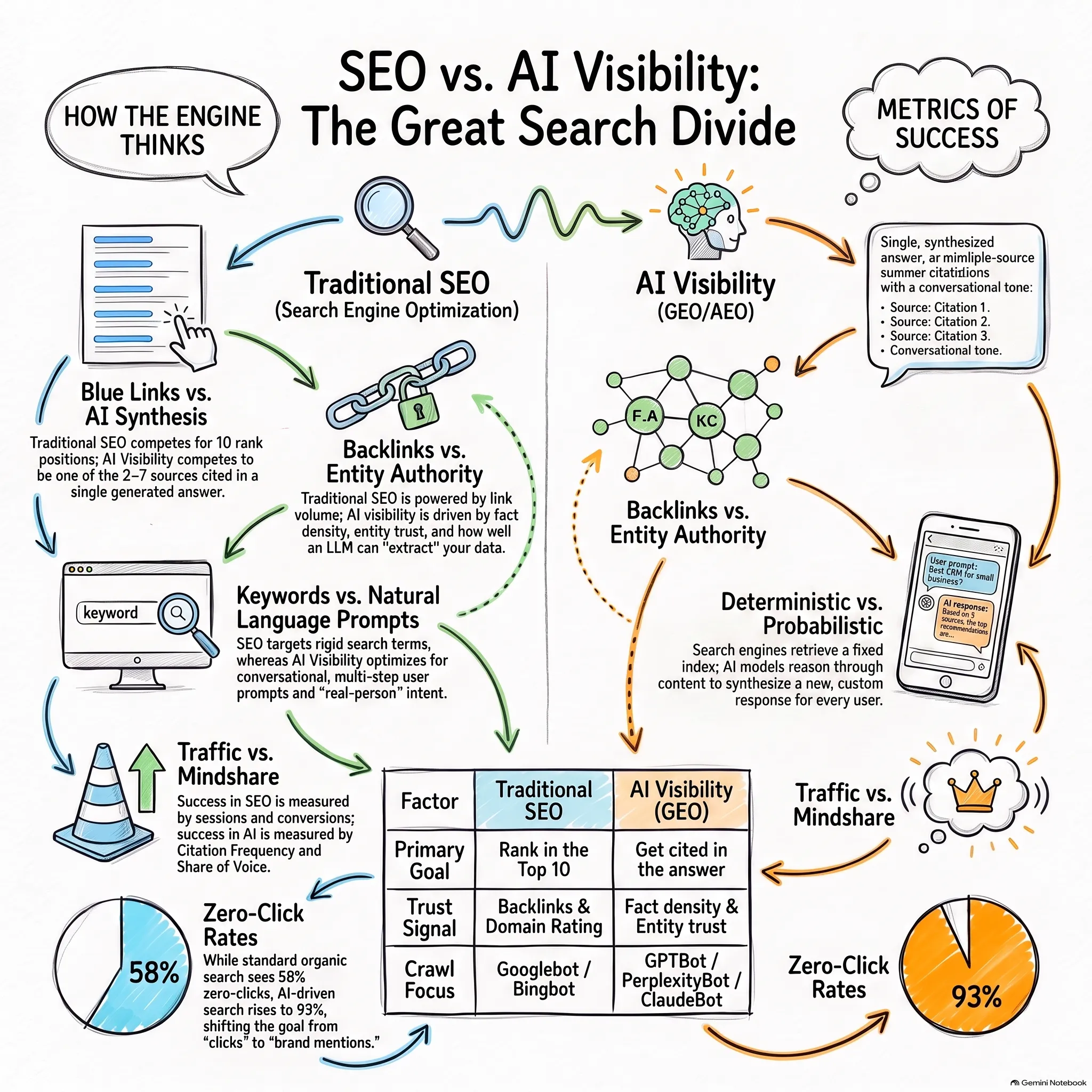
Traditional search trained people to compress a complex need into a few keywords: “best CRM for marketing agency.” Advanced users could add operators such as site:, quotation marks, -exclude, OR, or intitle:—but they still had to manually search, open links, compare options, and assemble an answer themselves.
AI search changes both the query and the experience. A buyer can provide detailed context in one prompt:
“I run a 10-person marketing agency in India. We use Google Workspace and Slack, need simple reporting and a low learning curve, cannot justify a dedicated CRM admin, and want to migrate from spreadsheets within a month. Compare the best options, use recent independent reviews, explain the trade-offs, and recommend one.”
The system can then interpret those constraints, retrieve and compare sources, apply saved preferences or custom instructions where available, ask follow-up questions, and produce a tailored recommendation rather than a generic list of links. Research modes, memory retrieval, connected data sources, and agents can make this process even more iterative and personal—turning a search query into a deeper decision-making workflow.
For brands, this raises the bar. It is no longer enough to rank for a broad keyword; your product must be understood and supported as a credible fit for many detailed, contextual variations of the same buyer need. If your brand is absent—or inaccurately framed—in that synthesized recommendation, a high Google ranking alone may not put you on the buyer’s shortlist. That is the AI Visibility opportunity.
AI Visibility vs. AI SEO: What’s the Difference?
AI Visibility and AI SEO are closely connected, but they are not the same thing.
AI Visibility is the outcome: how your brand appears across AI search and answer platforms.
AI SEO is the work: the technical, content, entity, digital PR, and measurement activities used to improve your AI Visibility over time.
Example: If Perplexity recommends your software in a “best tools” answer and cites your pricing guide, that is AI Visibility. Improving your product pages, building credible third-party coverage, making your content crawlable, and tracking those recommendations is AI SEO.
How Does AI Search Work (vs. Traditional Search)?
Traditional search usually returns a ranked list of links. The user chooses which result to open, compare, and trust.
Generative search takes a different path. It aims to interpret a question, retrieve relevant information, and produce a direct response. The answer may contain citations, links, product suggestions, summaries, comparisons, or follow-up prompts.
Although each platform has its own systems, the high-level process often looks like this:
- User asks a conversational question
- System interprets intent and expands the query
- Relevant pages, passages, and sources are retrieved
- The model synthesizes a response
- Sources may be cited to support claims
A prompt such as “What is the best CRM for a 10-person agency?” may lead an AI system to look for different kinds of evidence: pricing, agency-specific workflows, integrations, onboarding difficulty, user reviews, and product limitations.
This means: One page rarely wins because it uses a keyword most often. The system may assemble an answer from several sources, using each for a different claim. This is why AI Visibility is not a single ranking position—it is a changing pattern of mentions, citations, placement, and brand framing across many prompts and platforms.
What Are the Five Dimensions of AI Visibility?
A useful AI Visibility measurement framework should look beyond whether a brand was simply named once.
1. Brand Mentions
A brand mention occurs when an AI-generated answer names your company, product, or service. For example:
“For agencies that need lightweight reporting, PhantomRank may be worth considering.”
This is a mention even if there is no link to your site. Mentions matter because they show whether your brand is part of the model’s category understanding. But a mention alone does not prove that your website was used as evidence, nor does it reveal whether the model described you correctly.
2. Source Citations
A citation occurs when the AI platform links to or attributes a claim to a source. Depending on the platform, this may appear as an inline link, source card, favicon, footnote, or expandable reference list.
Citations are usually stronger than unlinked mentions because they show that a specific page contributed to the generated answer. However, a citation is not a universal “ranking signal” or guarantee of future inclusion. It is evidence of a source being selected in that particular answer, at that particular time.
3. Share of Synthesis
Share of Synthesis is a PhantomRank measurement concept for tracking how often a brand appears within AI-generated category answers relative to its competitors.
Traditional share of voice asks: “How visible are we in search results?” Share of Synthesis asks: “How much of the AI-generated answer space do we occupy when buyers ask relevant questions?”
For example, if your brand appears in 35 out of 100 tracked AI answers for a category while a competitor appears in 60, the competitor has a larger share of the generated conversation. This helps teams move beyond isolated wins and measure competitive presence at scale.
4. Answer Placement and Prominence
Where your brand appears in an answer matters. A company named in the opening recommendation list is likely to receive more attention than one mentioned in the final sentence after five competitors. Likewise, a cited source that supports the main conclusion can be more valuable than one used for a minor detail.
Placement should be measured carefully because layouts differ by platform and can change frequently. Still, the practical rule is simple: being present is good, but being early, relevant, and clearly recommended is better.
5. Sentiment and Framing
AI systems do not only mention brands. They describe them. A model may frame your company as:
- A category leader
- A specialist for a particular use case
- A lower-cost alternative
- Enterprise-focused
- Easy to use
- Limited in integrations
- Better suited to a competitor’s audience
This framing can influence buyer perception before they ever visit your website. AI Visibility therefore includes qualitative monitoring: not just “Were we mentioned?” but “What did the model say about us, and was it accurate?”
| Dimension | Definition | What It Means |
|---|---|---|
| 1. Brand Mentions | AI-generated answer names your company, product, or service | Shows whether your brand is part of the model’s category understanding, but doesn’t prove your website was the evidence source |
| 2. Source Citations | AI platform links to or attributes a claim to your website or a source | Usually stronger than unlinked mentions; shows a specific page contributed to the answer |
| 3. Share of Synthesis | How often your brand appears in AI answers for a category vs. competitors | Measure competitive presence at scale; answers “How much of the AI-generated answer space do we occupy?“ |
| 4. Answer Placement | Where your brand appears in the answer (opening, middle, end, etc.) | Placement matters; being named early and with a clear recommendation is better than a late, minor mention |
| 5. Sentiment & Framing | How the AI describes your company (leader, specialist, lower-cost, enterprise-focused, etc.) | Influences buyer perception before they visit your site; can be accurate or inaccurate |
Why Don’t Google Rankings Guarantee AI Citations?
Ranking well in Google helps (pages must be crawlable and indexed), but AI systems introduce an additional selection step: they need content that can support a specific response.
Google explains that its AI features rely on the same foundational requirements as standard Google Search: pages need to be crawlable, indexed, and eligible to appear with a search snippet. There is no separate “AI Overview optimization trick” or special crawler required for inclusion.
However, AI-generated answers introduce another selection step: the system needs content it can use to support a specific response. That can create a gap between ranking and citation.
BrightEdge’s tracking found that only about 17% of sources cited in Google AI Overviews also ranked in the organic top 10 in its data set. Other studies have reported higher overlap, depending on the query sample, location, and methodology.
The dependable conclusion is not a fixed percentage—it is that organic rankings and AI citations are related, but not interchangeable.
A page may rank well but still fail to earn citations if it is:
- Vague or outdated
- Difficult to extract information from
- Overly promotional
- Missing the specific evidence the model needs
On the other hand, a page outside the top organic positions may be selected because it contains:
- A strong original statistic
- A direct explanation
- A clearly formatted comparison table
- A useful first-party source
Where Do AI Systems Find Brand Evidence?
AI answers draw from your own website, but brands are often evaluated through a wider ecosystem. That ecosystem may include:
- Product and service pages
- Help centres and documentation
- Independent reviews
- Comparison articles
- Industry publications
- Directories such as G2 or Capterra
- Community discussions and forums
- Reddit threads
- Research reports and original data
- Analyst coverage and expert commentary
This matters most for recommendation-style prompts such as “best project management tool for agencies” or “which AI visibility platform should I use?” For those questions, a self-published claim like “we are the best platform” is rarely sufficient on its own. AI systems often need corroboration from sources that explain what you do, who you serve, how you compare, and why people trust you.
Perplexity documents separate crawling controls for its indexing and user-request bots, and confirms that its crawler respects robots.txt directives. That makes basic crawl access an important technical prerequisite, but it is only one piece of the larger visibility picture.
How Can You Improve AI Visibility?
There is no button that guarantees citations. But you can make it easier for AI systems to discover, understand, validate, and use your information.
Start with these priorities:
- Keep key pages crawlable and indexable — Google AI features rely on Google Search’s normal indexing systems. For other platforms, review the relevant bot controls, CDN rules, and bot-protection settings.
- Use direct answers near the top of important sections — If a page answers a question, state the answer clearly before expanding on it.
- Publish information worth citing — First-party data, transparent methodology, practical examples, expert analysis, product documentation, and genuinely useful comparisons are more defensible than generic marketing copy.
- Make your entity clear — Keep your company name, product description, founder or author information, use cases, and key claims consistent across your site and major third-party profiles.
- Build third-party proof — Earn legitimate reviews, media coverage, expert references, community discussions, and directory presence where relevant to your category.
- Track real prompts over time — One manual search is not a measurement system. Monitor recurring buyer questions, competitors, citations, placement, and sentiment across multiple platforms.
For ChatGPT Search, OpenAI distinguishes between OAI-SearchBot, which is used for search, and GPTBot, which relates to model training. Allowing or blocking one does not automatically control the other.
Anthropic similarly distinguishes between crawlers used for training, search indexing, and user-initiated requests. If Claude visibility matters to your business, review Claude-SearchBot separately from ClaudeBot.
Why Is AI Visibility Not Static?
AI Visibility is probabilistic and platform-specific. The same prompt can produce different sources in Google AI Overviews, ChatGPT Search, Perplexity, Gemini, and Claude. Results can also change based on location, product updates, index refreshes, news cycles, prompt wording, and the model’s evolving retrieval systems.
That means you should not treat a single citation as a permanent victory—or a single missed mention as proof that your strategy failed. The better approach is to measure patterns:
- Which prompts consistently include your brand?
- Which competitors appear more often?
- Which domains are repeatedly cited?
- What claims does each platform associate with your company?
- Where are you visible but inaccurately framed?
- Which pages earn citations, and for what type of question?
AI Visibility turns those questions into a repeatable measurement and optimization program.
How Do You Move From Visibility to Action?
AI Visibility tells you whether your brand is present in the generated answer layer. AI SEO is how you improve it. Once you have measured your baseline, the next step is to identify citation gaps, diagnose why competitors are selected, improve your content and entity signals, and track whether those changes affect your presence over time.
Explore the next guides in this hub:
- How AI Search Actually Works vs Traditional Search
- AEO vs GEO vs AI SEO: What’s the Difference?
- Why Google Rank Doesn’t Equal AI Citation
- How to Improve Your AI Visibility
- What an AI Visibility Audit Includes
Frequently Asked Questions
Is AI Visibility the same as AI SEO?
No. AI Visibility is the outcome: how often and how well your brand appears in AI-generated answers. AI SEO is the strategy and set of actions used to improve that outcome.
Do high Google rankings guarantee AI citations?
No. Strong organic rankings help because pages need to be crawlable and indexable, but AI systems can cite sources beyond the top organic positions when those sources provide more relevant, structured, or useful evidence for a specific answer.
Does Google AI Overviews use a separate AI crawler?
No. Google says there are no additional technical requirements or special AI optimizations required for AI Overviews or AI Mode. Your page must be indexed by Google and eligible to appear with a search snippet.
What is the difference between a mention and a citation?
A mention names your brand in an AI response. A citation links or attributes part of the answer to a particular source, such as a page on your website or a third-party publication.
How often should businesses measure AI Visibility?
Measure it regularly enough to spot meaningful changes, not individual fluctuations. For most teams, monthly tracking is a practical baseline; high-growth, high-competition, or agency environments may benefit from weekly monitoring of priority prompts.